Haebum Lee, PhD.
(Developer)
Postdoctoral Scholar
Jaffe Group,
School of STEM,
University of Washington (UW),
Bothell, WA, United States




Hello, and Welcome to my Web Application!
I am a scientist who focus on the multifaceted study of air quality and atmospheric phenomena, including the analysis of wildfire smoke on ozone, air pollutant monitoring, and the utilization of satellite and remote sensing data to assess atmospheric parameters. I am also deeply engaged in studying the wildfire smoke impacts on air quality, the physicochemical properties of atmospheric aerosols, the dynamics of new particle formation, and the development of predictive models using machine learning.
I hope everything is useful, thank you.
Research Interests
- Wildfire smoke impacts on air quality
- Air pollutant & air quality monitoring
- Analysis of atmospheric parameters using satellite and remote sensing data
- Physicochemical properties of atmospheric aerosols
- Observation of atmospheric new particle formation (NPF) and growth mechanisms
- Observation of nanoparticles at the remote (Arctic), urban, and agricultural sites
- Development of NPF-related and particle morphology prediction model using machine-learning techniques
- Characterization of nanoparticles and sub-micrometer particles in the ambient atmosphere
- Analysis of morphology and elemental composition of ultrafine particles in the ambient atmosphere
Education & Experiences
-
Postdoc / 2023.04-present
Jaffe Group, School of Science, Technology, Engineering & Mathematics (STEM),
University of Washington (UW), Bothell, WA, United States -
Postdoc / 2022.08-2023.03
Center for PM2.5 monitoring research, School of Earth Science & Environmental Engineering,
Gwangju Institute of Science & Technology (GIST), Gwangju, Republic of Korea -
PhD / 2018.09-2022.08
Aerosol Technology Monitoring Lab (ATML), School of Earth Science & Environmental Engineering,
Gwangju Institute of Science & Technology (GIST), Gwangju, Republic of Korea -
Researcher / 2018.03-2018.08
Aerosol Technology Monitoring Lab (ATML), School of Earth Science & Environmental Engineering,
Gwangju Institute of Science & Technology (GIST), Gwangju, Republic of Korea -
MS / 2016.03-2018.02
Aerosol Technology Monitoring Lab (ATML), School of Earth Science & Environmental Engineering,
Gwangju Institute of Science & Technology (GIST), Gwangju, Republic of Korea -
BS / 2010.03-2016.02
Chemistry,
Kyung Hee University, Seoul, Republic of Korea
Technical skills
-
Software Engineering & Computer Programming
- ML Predictive Modeling: Designing robust Machine Learning using R for complex pattern recognition.
- Data Engineering & API Integration: Developing automated, API-driven data acquisition systems and real-time monitoring pipelines.
- Spatiotemporal Intelligence & GIS: Advanced Geographic Information System (GIS) analysis and 3D air mass trajectory modeling (HYSPLIT).
- Remote Sensing Data Analytics: Engineering precision image pretreatment and feature extraction pipelines for environmental sensing.
- Scalable Statistical Computing: High-level data wrangling and rigorous statistical validation for large-scale research and industrial datasets.
- Full-Stack Web Development: Proficiency in [R shiny] & [JavaScript and CSS] for building high-performance, interactive data applications.
-
Aerosol measurement techniques & Instrumentation
- Condensation particle counter (CPC)
- Scanning mobility particle sizer (SMPS)
- Diethlyeneglycol- Scanning mobility particle sizer (DEG-SMPS)
- Optical particle counter (OPC)
- Aethalometer (Measurement of BC mass concentration and absorption coefficient)
- Organic and elemental carbons (OC/EC) analyzer
- Laser-induced breakdown spectroscopy (LIBS) technique
- Construction of the optic chamber for LIBS system
- Construction of face mask and filter test measurement system
- Lab-scale particle generation using Atomizer
Projects
Wildfire & Air Quality
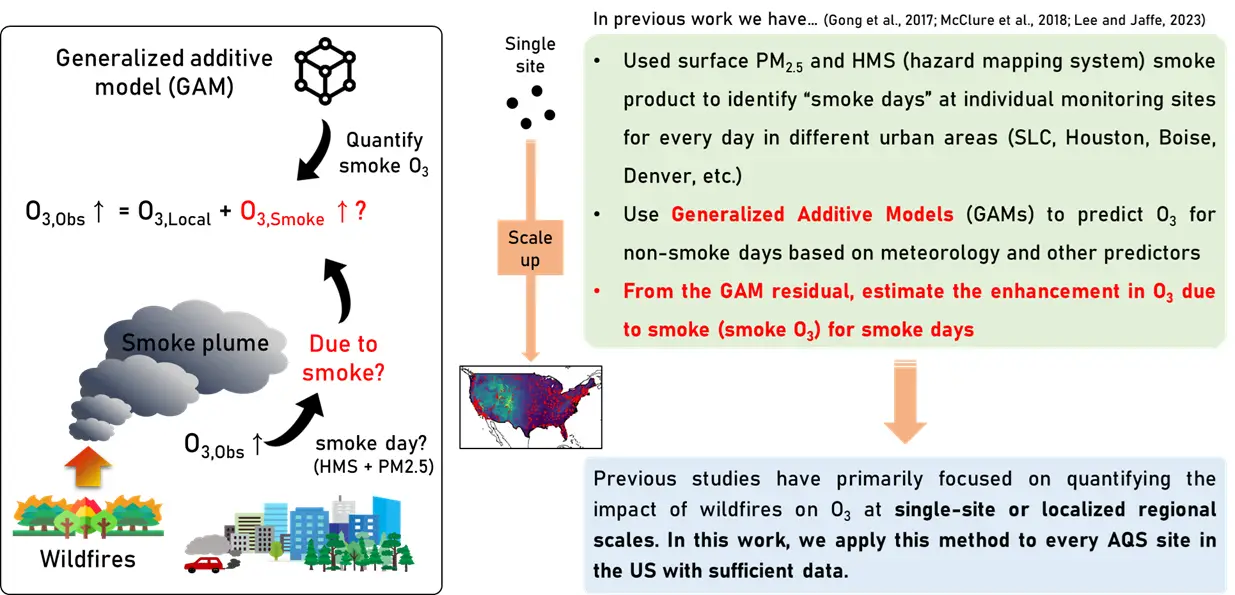
Impact of wildfire smoke on air quality in the United States
Objectives: Quantifying the impact of wildfire emissions on surface ozone
Dates of project initiation and completion: 2023.04.–present
📚 Related Publications
- Lee, H. and Jaffe, D. A.: Impact of Wildfires on O3 and Air Quality Across the United States for 2019–2024 Using Generalized Additive Models, J. Geophys. Res.: Atmos., 130, e2025JD044088, 2025. https://doi.org/10.1029/2025JD044088
- Lee, H. and Jaffe, D. A.: Wildfire impacts on O3 in the continental United States using PM2.5 and a generalized additive model (2018–2023), Environ. Sci. Technol., 58, 14764–14774, 2024. https://doi.org/10.1021/acs.est.4c05870
- Lee, H. and Jaffe, D. A.: Impact of wildfire smoke on ozone concentrations using a Generalized Additive model in Salt Lake City, Utah, USA, 2006–2022, J. Air Waste Manag. Assoc., 74, 116–130, 2024. https://doi.org/10.1080/10962247.2023.2291197
- Jaffe, D. A., Ninneman, M., Nguyen, L., Lee, H., Hu, L., Ketcherside, D., Jin L., Cope, E., Lyman, S., Jones, C., ONeli, T., Mansfield, M. L.: Key results from the Salt Lake regional smoke, ozone and Aerosol study (SAMOZA), J. Air Waste Manag. Assoc., 74, 163–180, 2024. https://doi.org/10.1080/10962247.2024.2301956
PM2.5 Characteristics
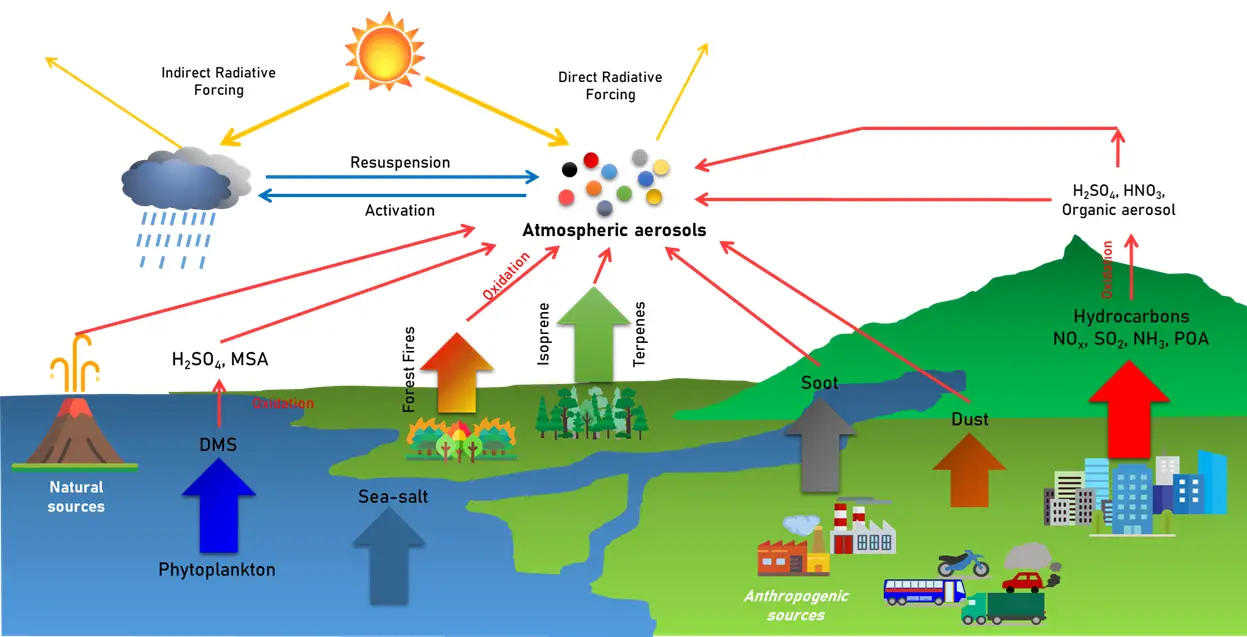
A study on the comprehensive characteristics of fine particulate matter (PM2.5)
Objectives:
1) Analyzing the chemical composition, sources, and transport of PM2.5 in winter haze over China and Korea and spring pollution over the Yellow Sea.
2) Developing advanced classification methods using machine learning to better understand fine particle characteristics and their health impacts.
3) Evaluating the performance and sustainability of face masks in filtering fine particles under various environmental conditions.
Dates of project initiation and completion: 2017.01.–2022.12.
📚 Related Publications
- Khadgi, J., Lee, H., Seo, J., Hong, J.-H., and Park, K.: Morphological classification of fine particles in transmission electron microscopy images by using pre-trained convolution neural networks, Aerosol Sci. Technol., 1–10, 2024. https://doi.org/10.1080/02786826.2024.2322010
- Park, M., Lee, S., Lee, H., Denna, M. C. F. J., Jang, J., Oh, D., Bae, M.-S., Jang, K.-S., and Park, K.: New health index derived from oxidative potential and cell toxicity of fine particulate matter to assess its potential health effect, Heliyon, 10 (3), e25310, 2024. https://doi.org/10.1016/j.heliyon.2024.e25310
- Kwak, N., Lee, H., Maeng, H., Seo, A., Lee, K., Kim, S., Lee, M., Cha, J. W., Shin, B., and Park, K.: Morphological and chemical classification of fine particles over the Yellow Sea during spring, 2015–2018, Environ. Pollut., 305, 119286, 2022. https://doi.org/10.1016/j.envpol.2022.119286
- Lee, H., Kim, S., Joo, H., Cho, H.-J., and Park, K.: A study on Performance and Reusability of Certified and Uncertified Face Masks, Aerosol Air Qual. Res., 22, 210370, 2022. https://doi.org/10.4209/aaqr.210370
- Eom, S., Lee, H., Kim, J., Park, K., Kim, Y., Sheu, G.-R., Gay, D. A., Schmeltz, D., and Han, S.: Potential sources, scavenging processes, and source regions of mercury in the wet deposition of South Korea, Sci. Total Environ., 762, 143934, 2021. https://doi.org/10.1016/j.scitotenv.2020.143934
- Park, M., Wang, Y., Chong, J., Lee, H., Jang, J., Song, H., Kwak, N., Borlaza, L. J. S., Maeng, H., Cosep, E. M. R., Denna, M. C. F. J., Chen, S., Seo, I., Bae, M.-S., Jang, K.-S., Choi, M., Kim, Y. H., Park, M., Ryu, J.-S., Park, S., Hu, M., and Park, K.: Simultaneous measurements of chemical characteristics and oxidative potential of fine particles during winter haze period in urban sites in China and Korea, Atmosphere, 11, 292, 2020. https://doi.org/10.3390/atmos11030292
New Particle Formation (NPF)
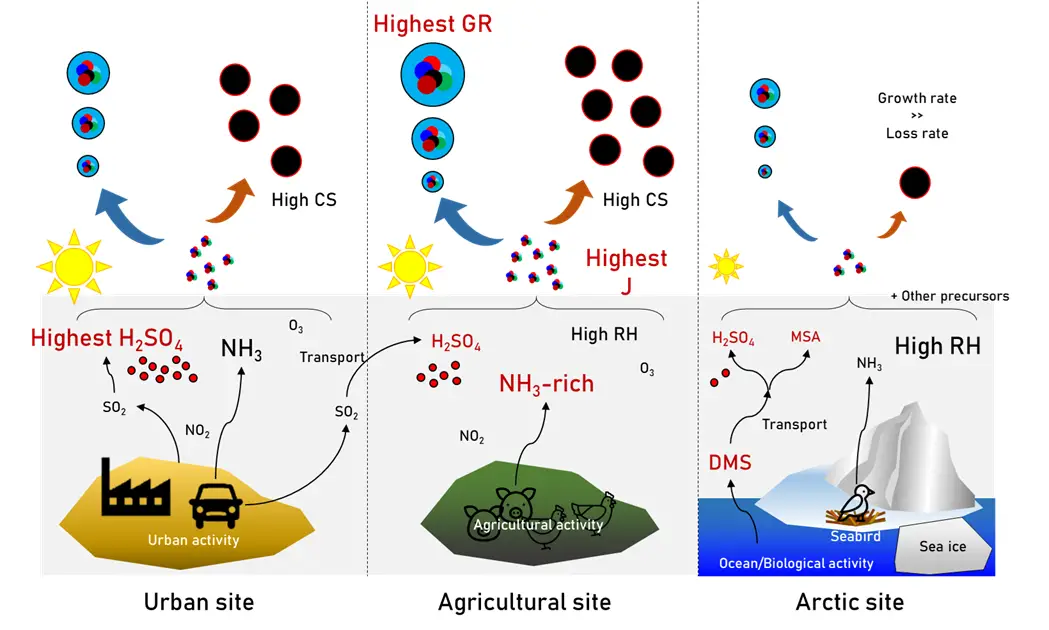
A study on new particle formation (NPF) in the ambient atmosphere
Objectives: Identifying differences of characteristics and governing factors for the NPF among sites
Dates of project initiation and completion: 2018.01.–2022.12.
📚 Related Publications
- Lee, H., Cho, H., Kim, J., Yoon, Y. J., Lee, B. Y., and Park, K.: Comparison of new particle formation events in urban, agricultural, and Arctic environments, Atmos. Environ., 120634, 2024. https://doi.org/10.1016/j.atmosenv.2024.120634
- Lee, H., Lee, K., Krejci, R., Fiebig, M., Lunder, C. R., Aas, W., Park, J., Park, K.-T., Lee, B. Y., Yoon, Y.-J., and Park, K.: Atmospheric new particle formation characteristics in the Arctic as measured at Mount Zeppelin, Svalbard, from 2016 to 2018, Atmos. Chem. Phys., 20, 13425–13441, 2020. https://doi.org/10.5194/acp-20-13425-2020
LIBS System Development
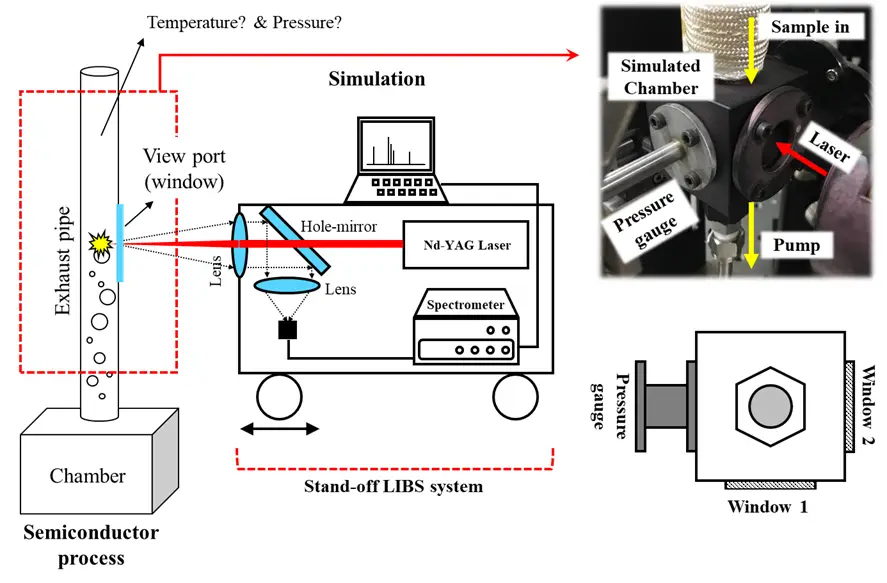
Development of laser-induced breakdown spectroscopy (LIBS) system
Objectives: Exploring the potential of LIBS technique in analyzing elements in flowback water from fracking operations and in detecting contamination particles in industrial processes
Dates of project initiation and completion: 2017.03.–2020.02.
📚 Related Publications
- Lee, H., Kim, G., Kim, H.-A., Maeng, H., Park, H., and Park, K.: Application of laser-induced breakdown spectroscopy for detection of elements in flowback water samples from shale gas wells, Applied Optics, 59, 2254–2261, 2020. https://doi.org/10.1364/AO.381687
- Kim, G., Kim, K., Maeng, H., Lee, H., and Park, K.: Development of Aerosol-LIBS (Laser-Induced Breakdown Spectroscopy) for Real-time Monitoring of Process-induced Particles, Aerosol and Air Quality Research, 19, 455–460, 2019. https://doi.org/10.4209/aaqr.2018.08.0312
- Lee, H., Maeng, H., Kim, K., Kim, G., and Park, K.: Application of laser-induced breakdown spectroscopy for real-time detection of contamination particles during the manufacturing process, Applied Optics, 57 (12), 3288–3292, 2018. https://doi.org/10.1364/AO.57.003288
- Maeng, H., Chae, H., Lee, H., Kim, G., Lee, H., Kim, K., Kwak, J., Cho, G., and Park, K.: Development of laser-induced breakdown spectroscopy (LIBS) with times ablation to improve detection efficiency, Aerosol Science and Technology, 51, 1009–1015, 2017. https://doi.org/10.1080/02786826.2017.1344352